Cracking the Code: What Those Numbers on Your Hermès Scarf Tag Actually Mean Part II
Recently, we have had folks generously share that Hermès’ laminated labels can look very different, depending on the season, country, and how Hermès felt that particular month. Even if they look very different, they typically contain some useful information.
Here are two things that are typically shown on the label that are not easily available elsewhere.
The batch code
A modern-day label will typically have a batch code, which is a year and month when the scarf was manufactured. Initially, they were just 4 digits (e.g., 1112 for December 2011), but around April 2018, Hermes started prepending letters HTH to the code (no idea what they mean) but using the same YYMM format; for instance, HTH1805 is May 2018. However, there have been some authentic laminated tags since 2018 that didn’t have the HTH letters.
These codes are useful for dating the scarf and will roughly correspond to the scarf season. 99% of the time, a scarf manufactured in January will be part of the spring-summer collection; a scarf manufactured in July will be part of the autumn-winter collection.
Batch codes suggests scarves are manufactured year-round and often hit the stores pretty quickly after they are manufactured.
Designs seem to be made in batches, with most designs printed in 1 or 2 adjacent months. There have been examples where printing was scattered across multiple months, likely because demand is high and additional production runs were made. I have seen tags indicating the Dans un Jardin Anglais was printed between August 2014 and June 2015, which is a very long production run.
Fun fact — I have collected thousands of batch codes, and it is clear that Hermès makes a lot fewer scarves in August (which makes sense, given that France pretty much goes on vacation then). See the attached image.
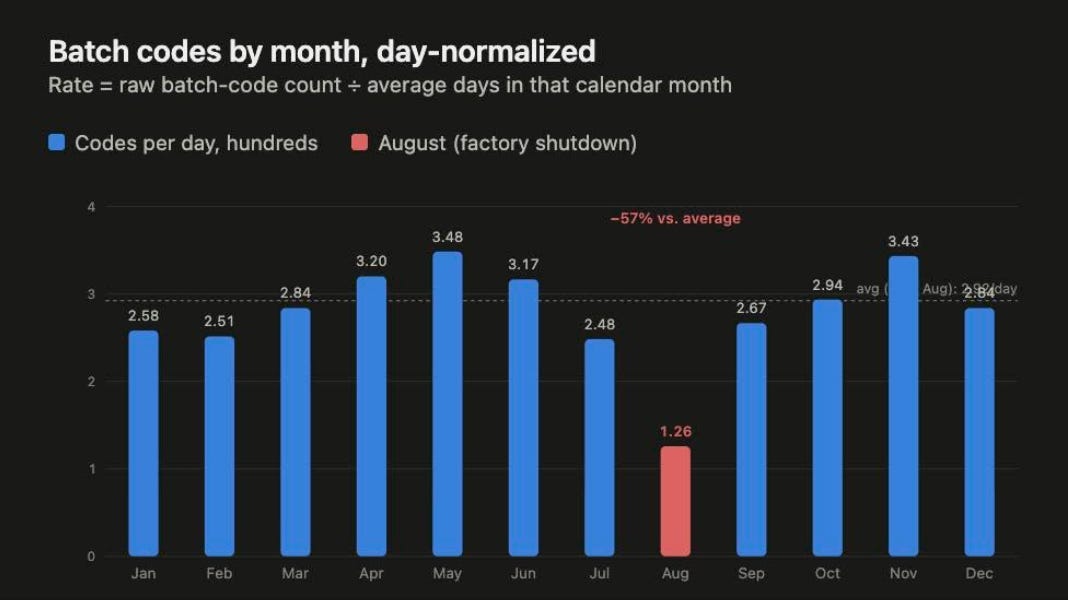
(These are not actual counts of all the scarves Hermès makes; this is based on what I have handled and seen, but the large sample size suggests it should be an accurate reflection of the overall pattern)
The color family
Starting in spring-summer 2018, Hermès started prepending color family codes to the labels. The idea of color families is not that new to Hermès — there have been many seasons where certain colors clearly dominated. But this was the first time the color story really got streamlined. These color family codes are displayed on the tag, but not on the website (a couple countries’ websites showed them briefly, but it didn’t last).
For instance, a Hermès Parade 90cm cw03 may have the tag say ‘PN/Gris Bleuté/Vert A’, while the website will say Gris Bleuté/Vert Amande/Orange. In this case, PN is the color family.
The color family codes are typically used for the women’s collection cashmere and silk items. Men’s items have their own color families, but they are usually not consumer-facing.
Color codes are two letters (e.g., CS, MB, FC, SR, SN…) and usually have a meaning, although it is rarely exposed to the general audience. E.g., SS2019 has an RD code that stood for Rose Denim.
There are varying numbers of color families per season, but the average is ~7. Because many designs have more than 7 colorways per issue, there are often several colorways per color family.
Most seasons, there is a ‘miscellaneous’ color family called HG, which seems to be a ‘catch-all’ code. They are often black-and-white scarves, but sometimes are in color as well. My best guess is that it stands for hors gamme, ‘outside the range’.
As always, all the information is based on my own research. I welcome all additions and corrections.
[Note: this post was originally written for and shared in a Facebook group for Hermès scarf collectors, but I wanted to ensure it is shared externally as well.]