Most folks who get into collecting Hermès scarves end up buying one or several books by Mme Geneviève Fontan, who has done a tremendous amount of work putting together information about scarves, their designers, issue years, etc.
Here is a link to the most recent edition. (This is not a sponsored post in any way or form).
Recently, Mme Fontan split her books into three: 1) the main book of ‘regular’ scarves, 2) the ‘limited edition’ book, and 3) the ‘special edition’ one. I own and use all of them, as well as the earlier and later editions.
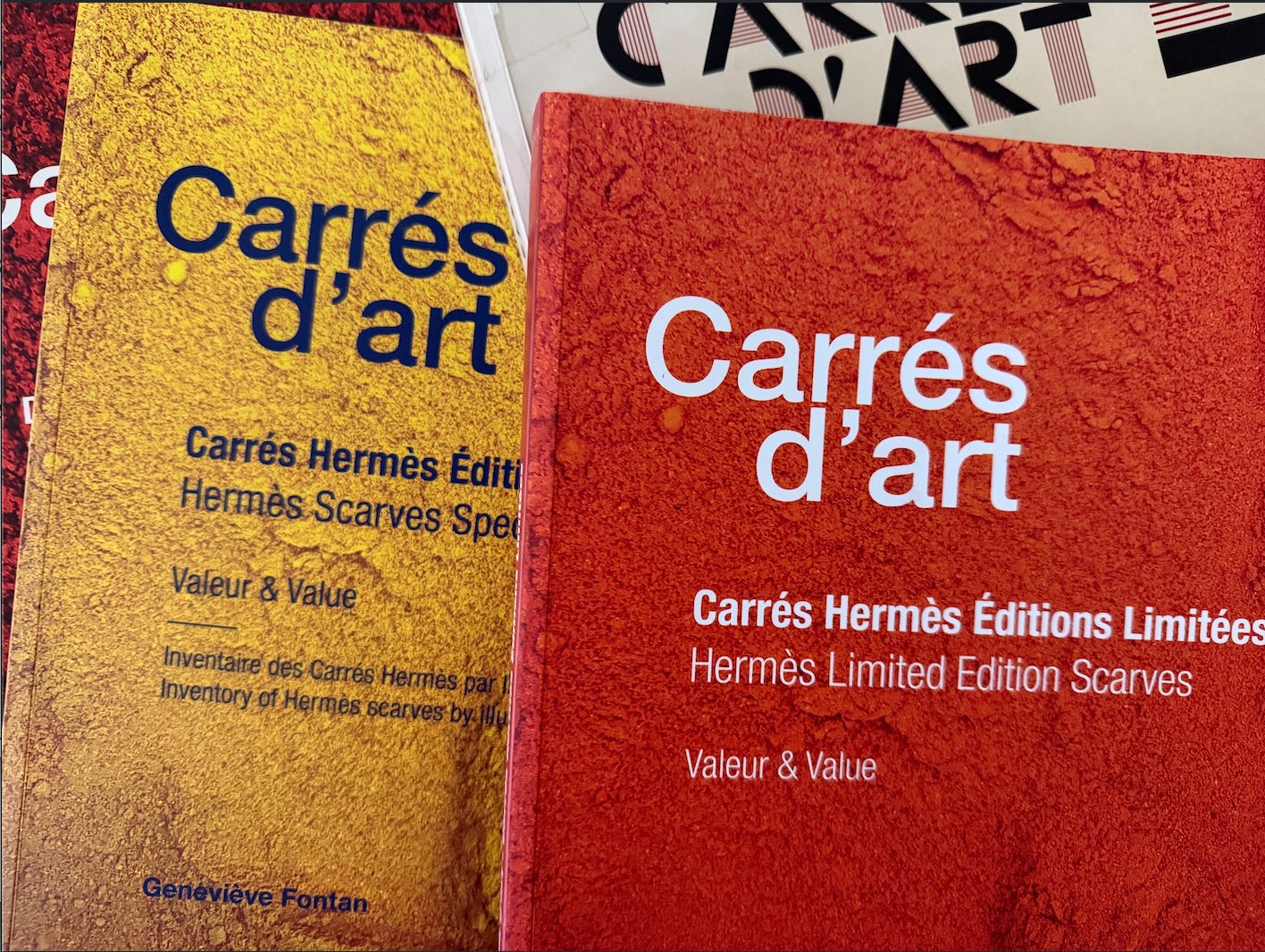
When I received my book order, I tried to figure out what the difference between special and limited edition was. I think it is as follows:
Limited editions are the existing designs that had a variation for a specific cause, which can be celebrating a company, an organization, an Hermès boutique, a sports event, etc. This can be a special colorway of the original design, or it might feature additional or edited wording on the scarf.
As an example, Alice Shirley’s Cocoricooooo! for the Bond St. boutique — it is based on a regular design, but has a special variation to celebrate the boutique (ref. H104064T)
Special editions are the designs that were designed specifically for a cause (which can be the same as above: a company, an event, a boutique).
A good example is the Centered Rhyme scarf by Elaine Lustig Cohen — it was designed specifically for the Glass House Foundation and has no other variations. Ref. H003139S.
This is the nomenclature I commonly see repeated and shared in the Hermès scarf collector universe, but I don’t agree with it. Before we get into the debate, let’s start with what Hermès actually calls them. Spoiler alert: there is no rhyme or reason to the Hermès nomenclature. At all.
Hermès doesn’t seem to have a clear terminology around anything ‘special’ scarf-wise. (I don’t mean the exceptional/precious scarves here). I am not familiar with an official distinction between the limited and the special editions.
If we think about the reference numbers, where H…S is a women’s collection and H…T is a men’s collection (see previous posts), some scarves are H…SC and H…TC, and these seem to represent their ‘special’ nature. (Fun fact: some laminated tags spell it S7 instead of SC, but what’s a little typo among scarf friends.)
The SC/TC format is quite rare, and there are very few reference codes that use it. Here are some examples:
The boutique-dedicated scarves:
The Cocoricoooo! I mentioned earlier —
H104064TC cw13 is the Bond St. edition that was available earlier this summer.
H104064T is the regular Alice Shirley design from SS2024. It was available in multiple colorways, including 04, 05, and 08.
The Monsieur et Madame II for Lillian Wightman / Le Louvre Melbourne
H002777SC in 2012.
H002777S is the regular design from AW2013.
The charity-dedicated scarves:
The Les Confessions Carré 90 for the French Scholarship Foundation
H002959SC — the 2016 version of an already existing scarf; cw 16 and only sold in the UK/London with 300 copies available.
The regular Les Confessions was H002959S in AW2015.
Miscellaneous:
The Serio Ludere maxi twilly —
H092809SC is the maxi twilly which was available only in Japan. It was available in at least 4 colorways in SS2014.
H002809S is the ‘regular’ Serio Ludere 90cm silk twill available internationally in AW2014.
The Bouquets Sellier 90cm silk twill —
H000594SC was described as Carré 90 Surteint and issued in around 2016/2017.
This is just your garden-variety dip dye. Dip dyes don’t typically have any ‘special’ indication on the tag. Except for this one.
Oh, and to confuse you even further, the cw 04 (Fuchsia) tag has the SC code, and the cw 03 (Rouge) didn’t. I think it was genuinely just a typo.
The regular Pierre Marie’s Bouquet Sellier (H002842S) was issued in SS2014.
You think you started seeing a pattern? Well, let me tell you about the scarves that don’t have an SC/TC designation at all:
Charity-dedicated scarves:
The Centered Rhyme scarf mentioned above (H003139S) — a very clear case of a scarf issued for a specific non-profit with no ‘special’ designation.
The Battery New-York (Battery Park) — H003164S — proceeds went to The Battery Conservancy, NYC.
The Panthera Pardus — H233012S — proceeds went to Panthera, focused on wildcat conservation.
Astrologie Nouvelle — H002707S — fundraiser for Bibliothèques Sans Frontières
And many, many others.
Boutique-dedicated scarves:
The Aloha Ala Moana Special Edition — H432026S — limited to 180 pieces.
Hommage à Gene Kelly — Madison Avenue — H983914S — Madison Ave boutique exclusive colorway.
And many, many others.
Miscellaneous:
Every other dip-dye scarf in history that I am familiar with (the H131698S Cavalcadour 140 in 2014, the H113553T C'est la Fête dip dye 90 in 2024, the H131266S Brides de Gala dip dye 90 in 2010, and many others).
All the Jungle Love Love scarves for Valentine’s Day that came in special heart-shaped boxes and had the heart-shaped print.
Brides de Gala Bayadère (Hermès pour Colette) — H002633S — sold only at the Colette pop-up, Paris.
And many, many others.
So yes, the conclusion is that there seems to be no apparent logic for what makes Hermès recognize something as more ‘special’ or ‘limited’ than other versions. No wonder collectors try to create their own logic to bring order to the scarf entropy.
I will discuss my own thoughts on the special/edition scarves classification in future posts. As always, I welcome comments, corrections, and additions.
Fascinating! I have all three of the books you mention here plus also keep my older editions of Mme Fontan’s book. The best enciclopedic source to identify Hermès scarves