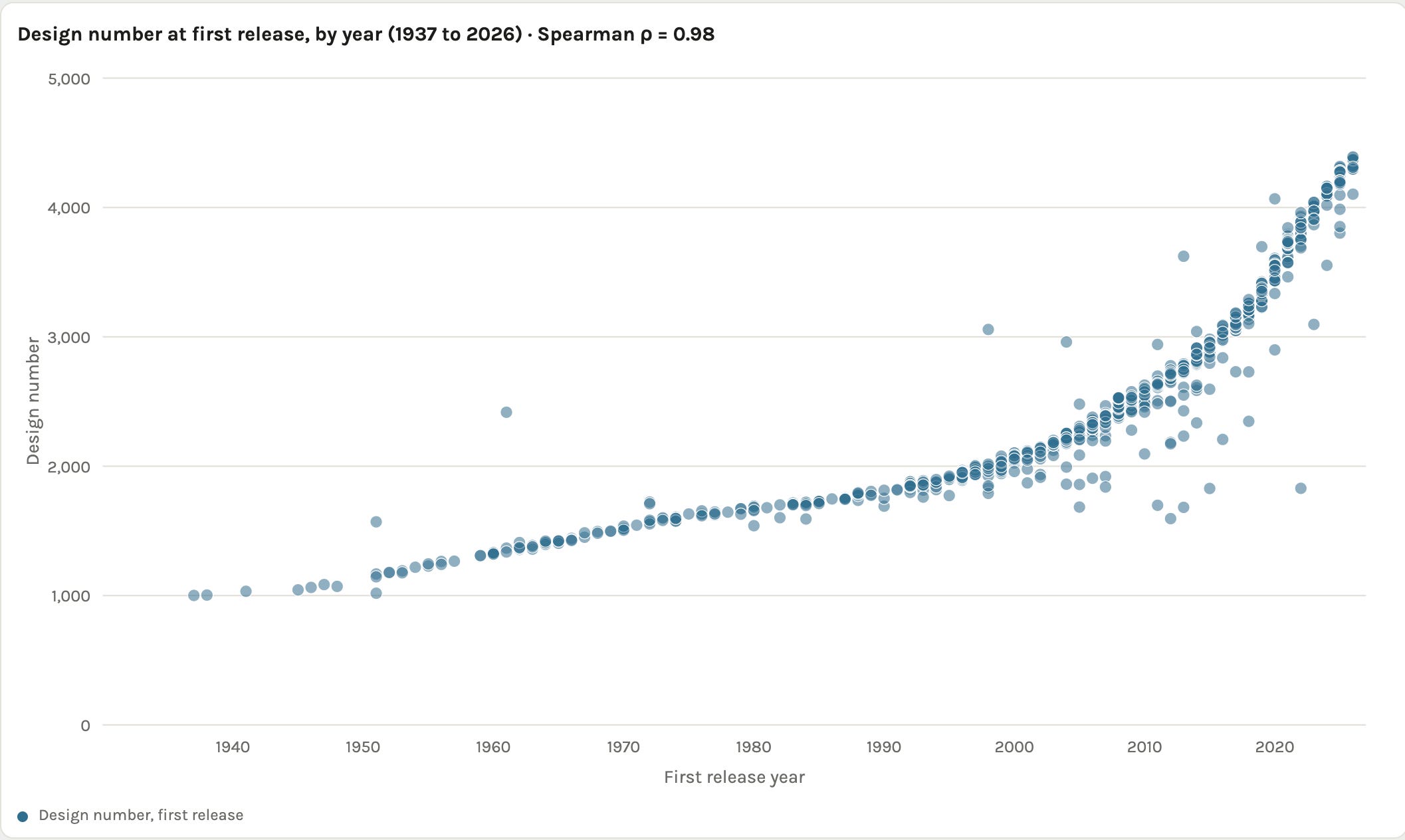
The lowest design number on the chart is 1001, Jeu des Omnibus et Dames-Blanches. The highest is above 4,300. Plot every design number against the year it first appears and the points fall along one curve. Once you know how to read that curve, it tells you a good deal about a piece before you check its label.
I have written about how Hermes reference numbers work (see here and onwards).
As a reminder, Hermès scarf reference codes typically follow the following pattern:
H + [2-digit format prefix] + [4-digit design number] + [1-letter collection suffix]
For example, the La Nature en Voyage 90cm silk twill scarf that is on H.com right now has the reference number H004368S:
H is the generic Hermes prefix
00 means a 90cm silk scarf
4368 is the design number
S means the women’s collection.
The design number is 4368, which in itself is pretty meaningless, except that it tells you with some confidence that this is a brand new Hermès design (not a reissue) that came out around 2026. Critical information, obviously!
I charted design numbers against the year each was first released, using my own records. The chart below plots about 860 designs. The trend is very clear, with a Spearman rank correlation of 0.98.
Keep in mind that the early Hermès releases didn’t use reference numbers the way they do now. The numbers for scarves such as Jeu des Omnibus et Dames-Blanches (1001, incidentally, since it was the very first scarf) come from later re-editions. Design numbers are reused unless there has been a significant change to the design. This is also why there are so many gaps in the 1930s to 1950s. Many of those designs haven’t been re-issued in recent history, so we don’t have an officially confirmed design number.
Here is an example of how some designs are organized:
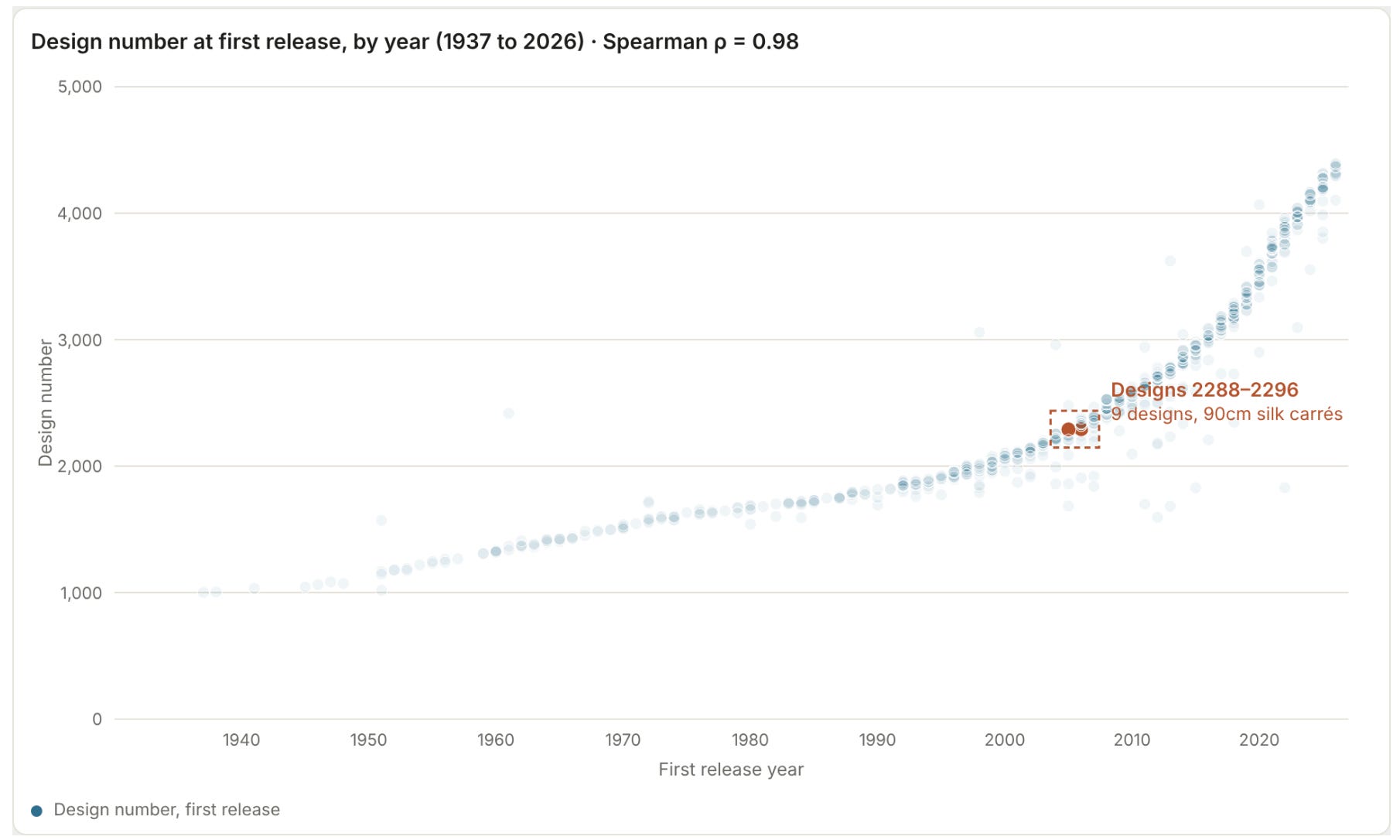
Spring-summer 2006:
2288 — Fleurs et Plumes
Autumn-winter 2005:
2289 — La Femme au Carré
2290 — Carré Boîte au Vol
2291 — H au Galop
Spring-summer 2006:
2292 — De Passage à Paris
2293 — Parures Océanes
2294 — Chemins de Garrigue
2295 — Les Petits Métiers de paris
2296 — En Désordre
As you can see, those year had 9 consecutive design numbers. But — not even the more recent decades have completely consecutive numbers. There are plenty of real gaps. I don’t know whether those numbers were designs considered but not chosen, or whether there is another reason.
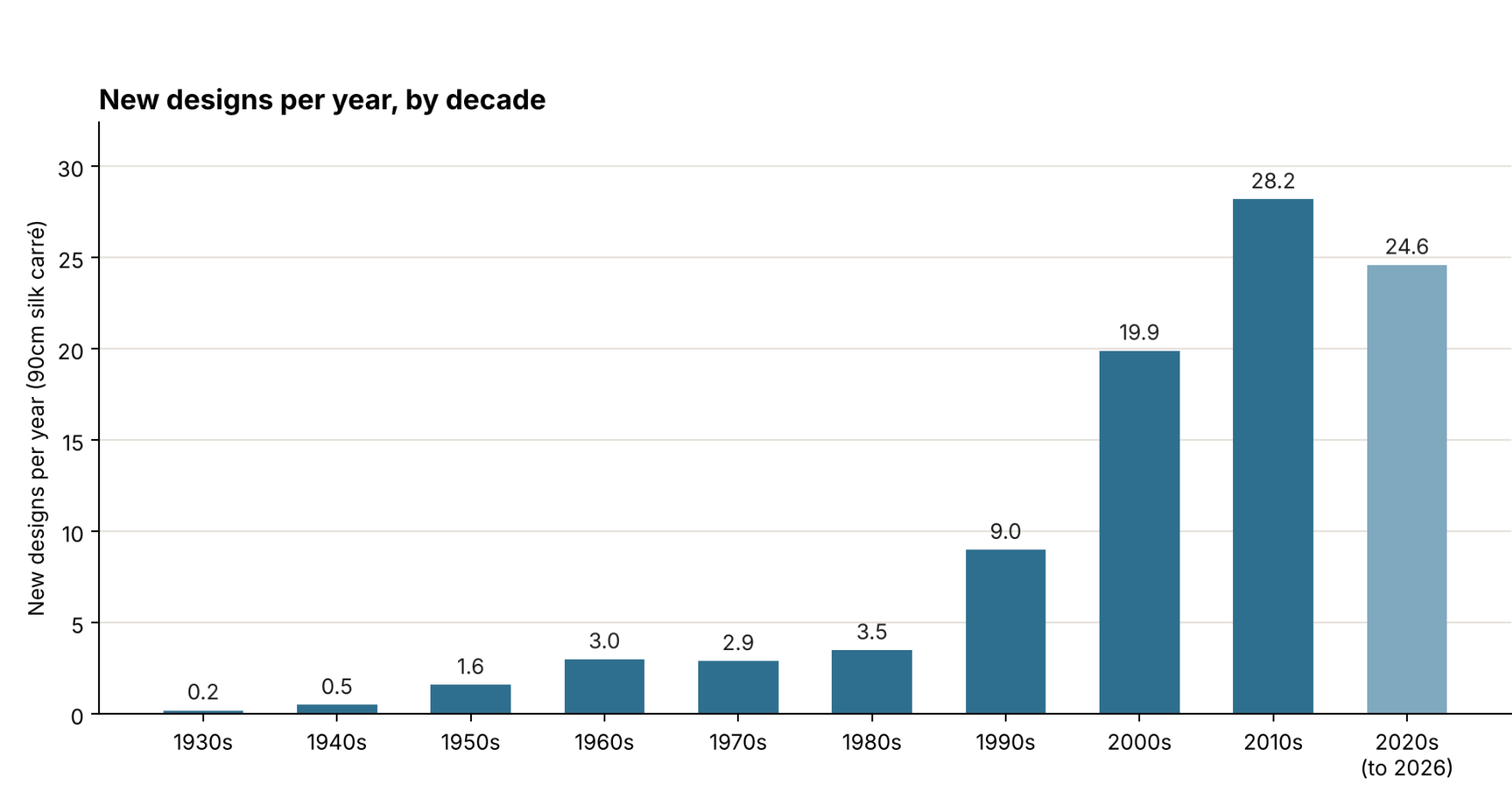
Another interesting fact is that the curve clearly slopes up, which means the number of new designs issued each year is increasing. This is not the same as the total number of scarves issued, since every season for the past several decades has featured many reissues.
Looking at net-new designs per year, the count has grown in almost every decade. The 1970s dipped slightly (it was a bad scarf decade overall), and the 2020s are a bit lower than the 2010a. Do note this is based on designs with known reference codes, which is why the earlier decades have such low numbers.
In general, it reflects the fact that Hermès only really built up its silk business from the 2000s onwards, producing more and more diverse designs.
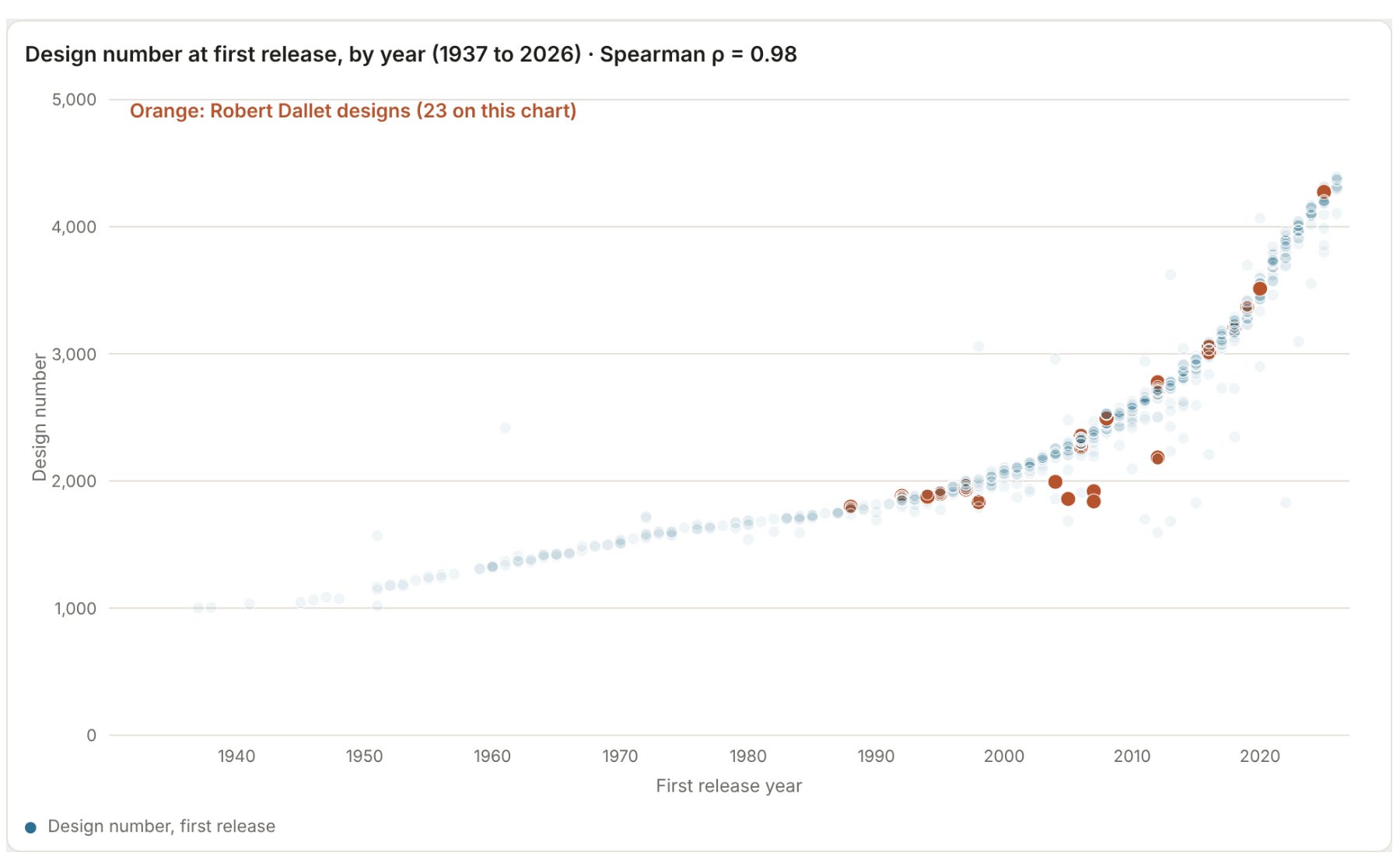
Not all the numbers sit on a perfect line. I think some of that reflects how Hermès does business. Looking at Robert Dallet’s designs, quite a few carry lower numbers than the curve predicts. My working theory is that many of them were numbered in 2006, after Dallet passed away, when Hermès has acquired his body of work.
Note: this system covers 90cm silk scarves and their basic iterations (CSGMs, 70cm vintage silks, pochettes, etc.). Pareos (even those based on the same designs), men’s designs, stoles, mufflers and so on use a completely different numbering system that I haven’t been able to decipher.
As always, all research is my own and based on my own data, which may not be complete. If you own one of these scarves, check the design number on its label against the year. Which piece in your collection sits furthest from the line? I’d like to hear about it in the comments.